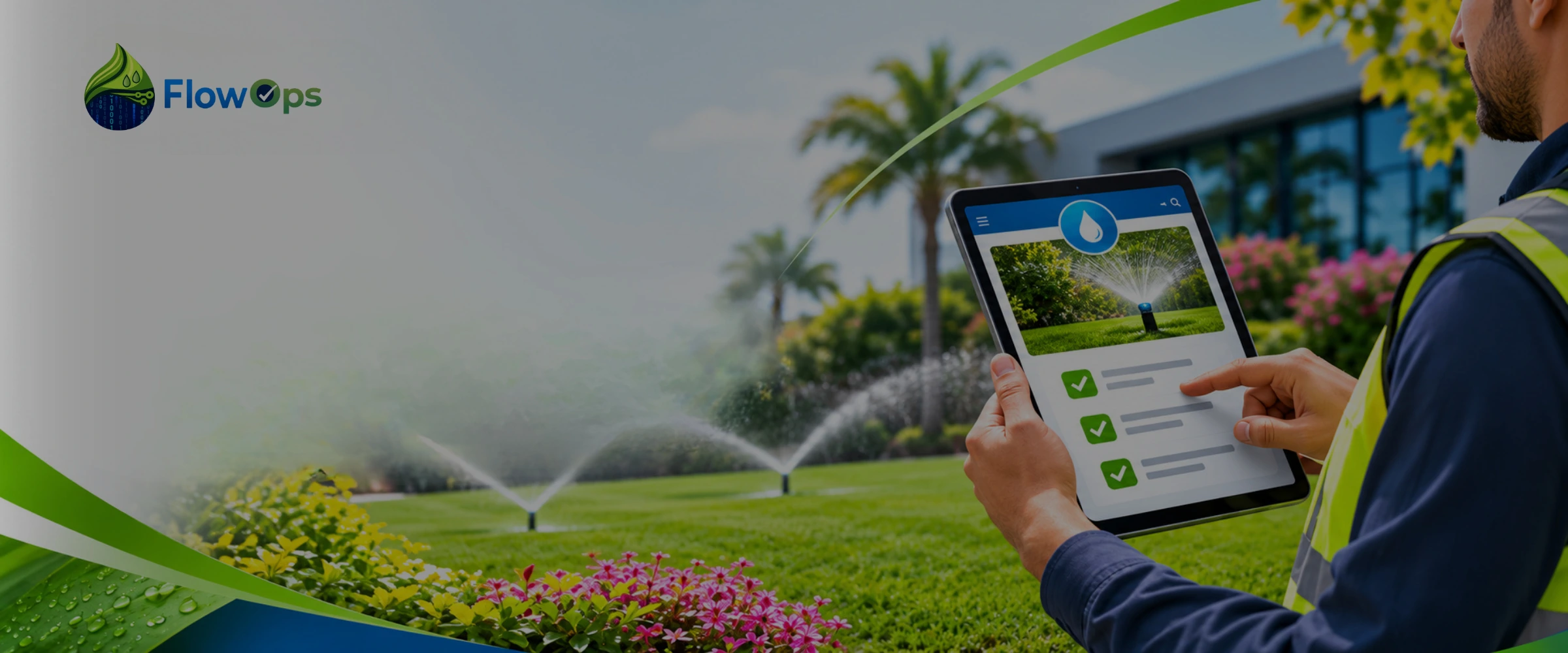
A technician picks up a new route in spring and pulls up to a commercial property for its first inspection of the season. The question that matters before they test a single zone is simple: what did the last wet check find here? If the answer lives in another technician's memory, a few photos on a phone that left when they did, and a line or two on a paper ticket in a folder at the office, the honest answer is that nobody knows. The property has been serviced for years, and its irrigation service record starts over every time the person holding the clipboard changes.
That's the gap a wet check inspection app is built to close. The problem isn't that the inspection gets run badly. The inspection gets done, the zones get tested, the problems get found. What doesn't happen is the record: the visit produces notes instead of a structured entry the next visit can build on, so a property that's been checked a dozen times has no continuous history of what was tested, what was found, and what condition it was left in. Each technician documents the way they know how. The app makes every wet check produce the same record, so the service history accumulates instead of resetting with the route.
A Service Record Is Only as Good as the Visit That Captured It
It helps to be clear about what a service record is supposed to do. Every wet check is a snapshot of an irrigation system's condition on a given day: which zones ran clean, which heads got replaced, which valve was starting to fail, what the controller was set to. Strung together across a season and across years, those snapshots are the service record, the thing that tells you whether a property's system is holding steady or slowly degrading, and the thing a client is really paying for over time.
But a record only accumulates if every visit adds to it in the same form. When one technician writes three lines and the next fills a page, when one documents on the property and the next reconstructs it that evening, when one photographs a failing head and the next doesn't, the visits don't stack into a history. They sit as separate, mismatched notes nobody can read as a trend. A wet check inspection app fixes that at the capture point, so every visit lands in the record the same way.
Where Irrigation Service Records Fall Apart
Service records come apart in a few predictable places, and none of them look like a problem on the day.
The first is capture from memory. A technician who writes up the visit back at the truck or that evening records what they remember, and memory keeps the big items and drops the small ones: the early-stage valve, the zone that ran a little weak. That's exactly the detail a service record exists to carry forward. The second is inconsistency between technicians. With no shared structure, the lead tech and the seasonal hire produce completely different write-ups of the same property, so the record changes character depending on who ran the route that week. The third is proof that walks off: photos taken on a personal phone leave when the technician does, so a documented condition from last season is gone by the next. And the fourth is the route handoff, where everything the previous technician knew about a system is lost if it was never captured in a form the next person can open.
None of this is a crew problem. The technicians are testing the system and finding real conditions. The problem is that without structure, what they find lives in notes and memory instead of a record, so the history a property should have after years of service never actually builds.
What a Consistent Service Record Takes
A consistent service record comes from making every inspection produce the same structured entry, no matter who runs it. A few things make that happen, and they all move the record out of memory and into a form the next visit can build on.
The inspection runs zone by zone, with each zone a required step, so every visit covers the same ground and the record has no silent gaps. Findings get captured on the property in the moment, not rebuilt at the truck, so nothing depends on recall. The same fields get filled on every inspection, so an inspection from a first-season hire carries the same information as one from the lead, and the entries line up when you read them in sequence. Photos are required on flagged conditions, so the proof stays with the record instead of on someone's phone. And because each entry is structured the same way, the visits accumulate into a history: the next technician opens the property and sees what the last wet check found, what got repaired, and what to watch. This is the difference between a tool that stores whatever each technician types and one that makes sure every visit adds the same kind of entry to the same record.
What Inconsistent Records Cost
The cost of an inconsistent service record is quiet, because a history that never got built doesn't show up as a loss. It just isn't there when someone needs it.
The first cost is repeated diagnosis. When a new technician can't see what the last inspection found, they start from zero on a system that's been serviced for years, re-finding problems that were already known and sometimes missing ones that got flagged and never followed up. The second is disputes the company can't answer: when a client claims a condition was missed or a repair wasn't needed, a service record with no zone-level entries and no photos gives the company nothing to point to. The third is client confidence. A property manager who asks for the service history on a site and gets a shrug starts to wonder what they're paying for, and that doubt is hard to walk back. The fourth is the slow one: without a consistent record, nobody can see a system degrading until it fails, because the early signs were in notes that never lined up into a trend. A consistent record protects the continuity, the proof, and the relationship at the same time.
How FlowOps Helps
FlowOps runs the wet check as a structured, zone-by-zone inspection in a mobile app the technician uses on the property. Each zone is a required step, findings are captured in the moment, and photos are required on the conditions that matter, so every inspection produces the same entry whether it's run by the lead tech or a first-season hire. As irrigation maintenance software, FlowOps keeps those entries in one continuous record per property, so the next visit opens on what the last one found instead of starting over.
Because FlowOps captures the findings as structured data, they also carry into what comes next. A failing valve documented in the field moves into Bid Generation as a quote without anyone rebuilding it, the completed repair becomes an invoice-ready field report the office can bill from, and direct ERP integration carries the record into the ERP the company already runs. That gives the field a consistent record and hands the office one it can work from, so a property's irrigation service history finally lives in one place instead of across a dozen clipboards.
A Record That Holds Up Is Worth More Than a Visit That Got Done
The value of a wet check was never only in getting the visit done. It's in what the visit leaves behind: a record the next technician, the office, and the client can all rely on. An inspection that finds real problems but leaves them in notes nobody can read later isn't building the thing a service relationship runs on.
When every wet check lands in the same structured record, captured on the property and backed by photos, the history accumulates. The next technician opens a property and knows it. The office can answer a client with a record instead of a guess. And a system that's slowly failing shows up as a trend instead of a surprise. That's where FlowOps fits. To see how a wet check inspection app keeps every irrigation service record consistent across your crews, request a demo.
Frequently Asked Questions
What is a wet check inspection app?
A wet check inspection app structures the irrigation inspection on a mobile device the technician uses in the field. Instead of a clipboard and notes written from memory, it runs the wet check zone by zone as required steps, captures findings on the property, and requires photos on flagged conditions, so every visit produces the same structured entry no matter who runs it. That consistency is what turns a set of separate visits into a service record.
How is it different from using a notes app or a camera roll in the field?
A notes app or a camera roll captures whatever the technician decides to record, in whatever form they choose, so two visits to the same property can look nothing alike. A wet check inspection app makes every visit follow the same required steps and fill the same fields, so the entries line up and accumulate into a history. The difference isn't that one is digital and the other isn't; it's that the app produces a consistent record the next visit can build on, and loose notes don't.
How does it keep irrigation service records consistent across technicians?
By moving the structure out of the technician's head and into the workflow. When every zone is a required step and the same fields are filled on every inspection, a first-season hire produces the same entry a veteran would, because the app asks the same questions either way. The service record stops depending on who ran the route and starts depending on the workflow, so the history reads the same from visit to visit.
Does it connect to the ERP?
Yes. Through direct ERP integration, the structured record moves into the ERP the company already runs, so nobody re-enters it before billing. The record the inspection produced is the same one the office bills from, rather than a separate write-up someone has to retype into another system.
Does it replace how technicians inspect in the field?
It structures the inspection. It doesn't change the expertise. Technicians still test the system the way they know how. What changes is that the app asks the same questions on every zone and every property, so the inspection is complete and the record is consistent regardless of who runs it. A newer technician produces the same thorough entry a veteran would, and the property's service record stays continuous as routes change.