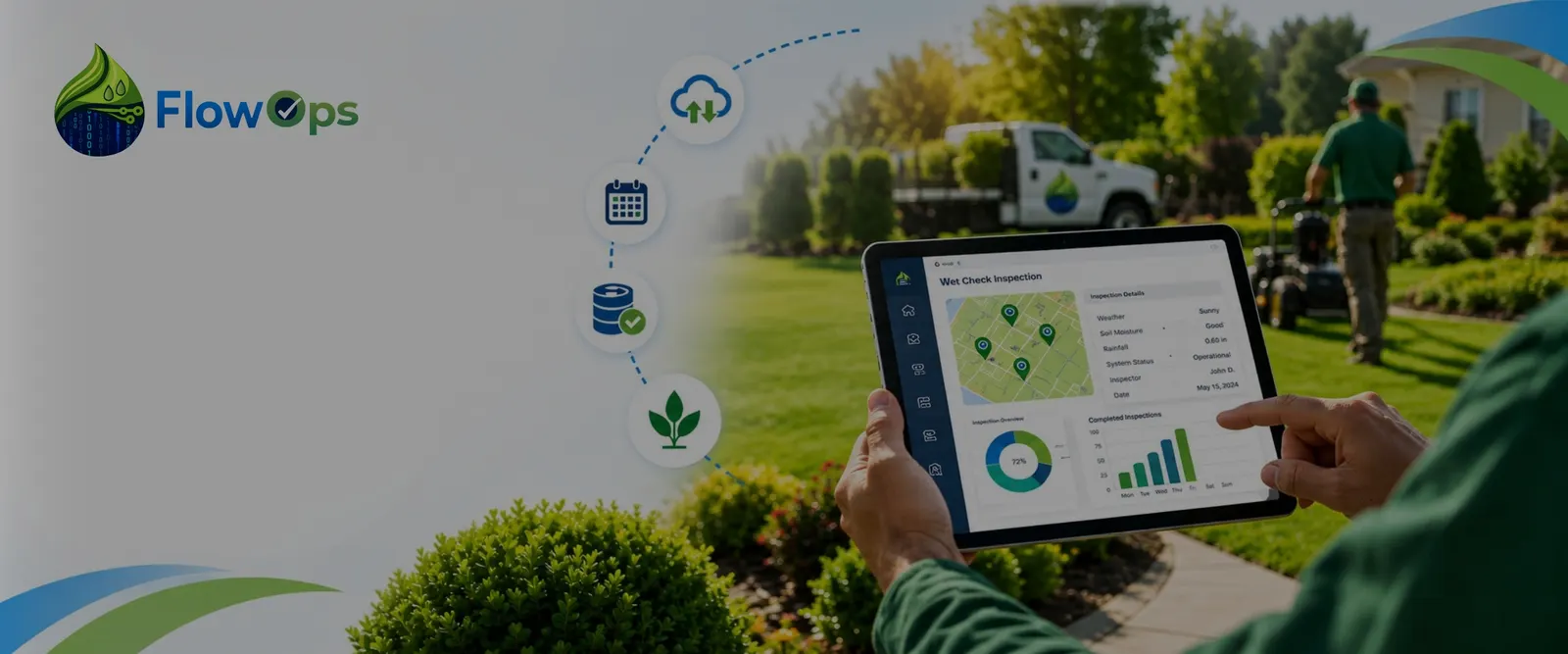
A crew runs a wet check on a commercial property and finds exactly what they should: a zone dropping pressure, two broken heads, a valve that's starting to weep. The inspection is accurate. The technician did the job. Then the findings get typed into a form at the end of the day, one zone gets logged as the wrong number, a photo doesn't make it onto the record, and the note about the valve just reads "check valve" with no sign of which one. By the time the report reaches the office, it's close to what happened on the property, but not exactly, and nobody can tell where it drifted.
That's the accuracy problem most companies actually have, and it isn't in the inspection. A wet check inspection app that improves accuracy, documentation, and reporting doesn't do it by making technicians better at finding problems. They already found them. It does it by making sure what they find is captured cleanly at the source, held as a record that holds up, and reported to the office without being rebuilt or garbled on the way. The inspection is rarely where the error enters. The handoff is. And accuracy, documentation, and reporting aren't three separate features to shop for. They're one chain, and it either holds from the field to the office or it breaks somewhere in between.
Accuracy Is About the Record, Not the Inspection
The technician's accuracy usually isn't the variable. They ran the zones, they saw the failing valve, they knew what they found. The variable is whether that knowledge survives the trip into a record intact. Errors don't tend to enter when a tech is looking at a sprinkler head. They enter afterward, when findings get transcribed from memory, entered into a form hours later, or written in shorthand that made sense on the property and doesn't at a desk a week on.
A purpose-built wet check app improves accuracy by closing that gap, capturing the finding at the moment and place it happens. Structured fields instead of free text mean a pressure reading is a number in a known slot, not a phrase someone has to interpret. Zone-level entries tie each finding to the exact zone it belongs to. Required fields keep a submission from going through without the static pressure or the photo. And photos captured inside the workflow attach to the zone as they're taken, so there's no later guessing about which image shows what. The record matches the property because it was built on the property, not reconstructed from a foreman's memory the following Monday.
Documentation Is What That Capture Becomes
Accurate capture only matters if it's held as something the office can retrieve. That's what documentation is here: the accurate finding, organized and tied to the property, job, date, and time, so it can be pulled months later without a search through camera rolls and text threads. This is the point where a wet check stops being a moment that happened and becomes a record that exists.
The two depend on each other. You can't document well what was captured loosely, and clean capture that's never organized into a retrievable record is just a tidier version of the same problem. When the capture is structured and the documentation is built from it automatically, the record is defensible in a dispute, referenceable for the property's history, and usable as the starting point for the next visit. A wet check documented this way answers the question a client asks three months later, and it does it from the record rather than from someone's recollection of a spring afternoon.
Reporting Is Where the Record Does Its Work
Reporting is the record reaching the people who act on it: the office that bills, the estimate that quotes the repair, the client who needs to know what was found. And here's the payoff of getting the first two right. If the capture is accurate and the documentation is structured, reporting isn't a separate job someone does later. The report is the record, formatted and sent, not a thing rebuilt from scratch at a desk.
That's what closes the loop the opening scenario left open. The failing valve captured accurately, documented in a structured record, moves into a report and into estimate creation without anyone re-reading a PDF and retyping it. It can become an invoice-ready field report and a client-facing summary from the same capture. The reason reporting can be trusted is that the accuracy was built upstream. A report is only as reliable as the capture underneath it, which is why these three can't really be separated. An error in the capture is an error in the document is an error in the report. Get the capture right and the other two mostly take care of themselves.
What Breaks When the Chain Doesn't Hold
When the capture isn't clean, the damage travels downstream and compounds. Findings entered from memory drift from what was actually on the property. Photos that aren't tied to a zone can't confirm what a note claims. Reports the office can't fully trust get verified with a phone call to the crew, which is the reconstruction work the app was supposed to remove. Estimates built on shaky findings come out wrong, or they wait while someone confirms the details, and a repair that could have been quoted the same day slides into next week.
The dispute case is where it bites hardest. When a client questions what was done, an accurate, structured, photo-backed record settles it quickly. A report that's roughly right but drifted somewhere between the field and the office gives the client room to push, and the company can spend more defending a charge than the charge was worth. None of these are inspection failures. The wet check was fine. They're what happens when accuracy, documentation, and reporting are treated as three things a tool does separately instead of one chain it has to hold together.
How FlowOps Helps
FlowOps captures the wet check the way the work happens: zone by zone, in a structured form, with static pressure, head and valve conditions, and photos tagged to the zone, all tied to the property and job, on the property, at the time of the visit. That's the accuracy, built in at the source rather than checked for afterward.
Because the capture is structured, it becomes a retrievable record without anyone organizing it, and it moves into reporting and estimating creation without anyone re-entering it. The failing valve the technician logged is the same failing valve on the estimate, in the property's record, and in the client's report. FlowOps handles accuracy, documentation, and reporting as the single chain they are, so what leaves the field is what reaches the office, unchanged. That's the difference between a connected wet check app and a tool that just digitizes the form.
The Report Is Only as Good as the Capture Underneath It
The inspection is rarely the weak point. Crews run accurate wet checks every day and find the problems that matter. The weak point is the distance between what they found and what the office ends up with, and every error, delay, and dispute that lives in that gap traces back to how the finding was captured in the first place.
When the wet check is captured accurately at the source, documented as a structured record, and reported without a rebuild, the office works from what actually happened on the property instead of a version of it. That's where FlowOps fits. To see how it keeps a wet check accurate from the field to the invoice, request a demo.
Frequently Asked Questions
What is a wet check inspection app?
A wet check inspection app is a mobile tool technicians use to run irrigation wet checks in the field: testing zones, logging pressure, and documenting broken heads, valves, and coverage problems with photos, the way purpose-built irrigation inspection software is meant to. The better wet check software captures findings as structured data and carries them into documentation and reporting, so what the technician found reaches the office as an accurate record rather than something that has to be rebuilt.
How does a wet check inspection app improve accuracy?
It captures findings at the moment and place they happen, instead of relying on notes written up later. Structured fields, zone-level entries, required fields, and photos tagged to the zone keep the record faithful to what was actually on the property. The inspection was already accurate. The app protects that accuracy through the handoff, which is where it usually gets lost.
What makes wet check documentation hold up in a dispute?
A record that's structured, time-stamped, photo-backed, and tied to the specific property and date. When a client questions what was done or what condition a site was in, that record answers with specifics instead of a recollection. Loose documentation, a few unlabeled photos and a general note, leaves the question open and the charge exposed.
How does a wet check app improve reporting?
When capture is accurate and documentation is structured, the report is the record, formatted and sent, not a separate job someone rebuilds at a desk. Findings can move into invoice-ready field reports, estimates, and client summaries from a single field capture, which speeds up billing and keeps the report faithful to what the crew actually found.
What should a wet check app capture in each zone?
At the zone level: which zones ran, static pressure, the condition of heads and valves, coverage or overspray issues, and any leaks or damage, each with photos tagged to that zone. Zone-level capture is what makes a finding specific enough to quote from and to defend later, rather than a single site-wide note that can't speak to one area of the property.