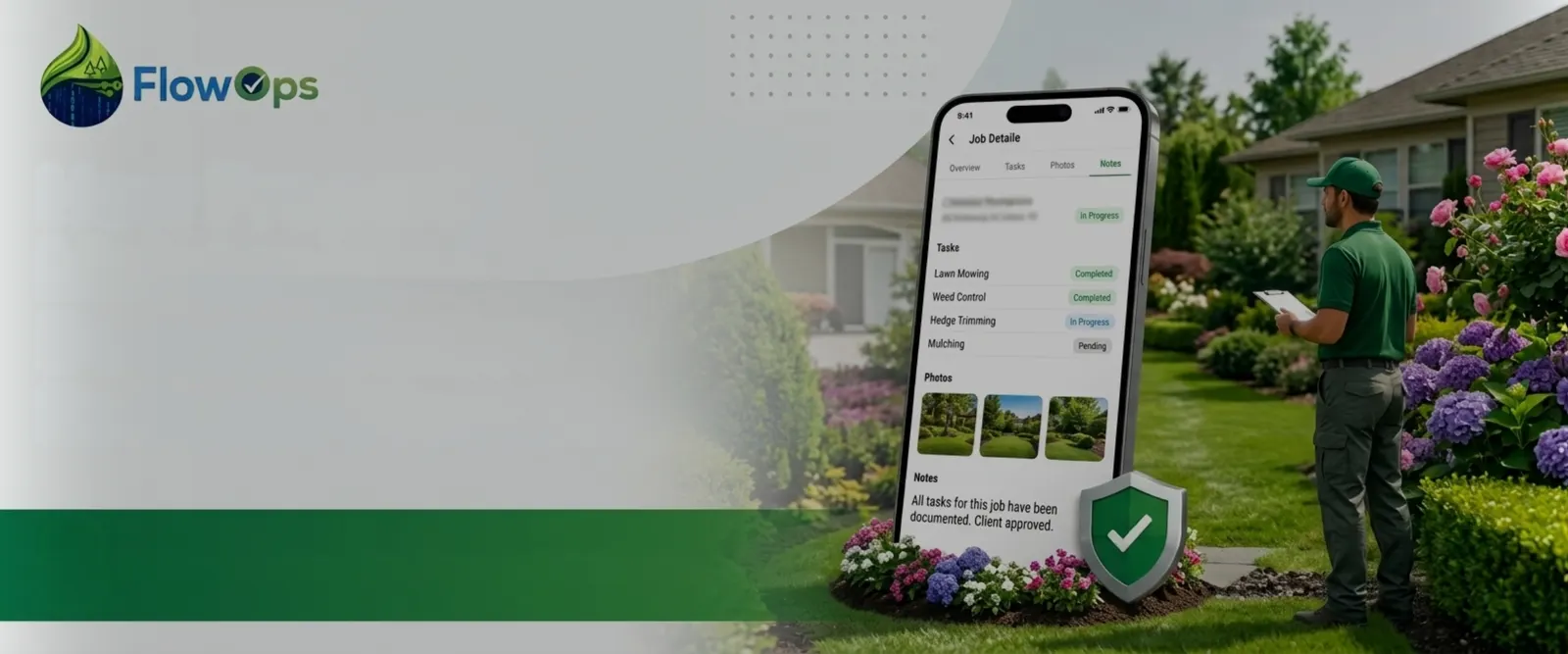
In property maintenance, most client disputes are not arguments about the quality of the work. They are arguments about the record of it. A property manager remembers a bed of shrubs being cut back too hard in March. The crew remembers pruning to the scope that was agreed. Both accounts are sincere, and without a record, neither can be settled. The disagreement is not really about what happened at the property. It is about what was documented, communicated, and retrievable months later, once two sets of memories have drifted apart.
This is the part that gets misread. When a dispute lands, the instinct is to defend the work. But the work is rarely where it broke. Crews complete the service, handle the grounds, and move to the next site. The breakdown is that what they did and observed never became structured property maintenance documentation that the office and the client could both see. The dispute is that information gap surfacing on a delay.
Where Client Disputes Actually Start
A dispute rarely begins at the moment a client is unhappy with the work. It begins earlier, at a point where information should have been recorded and was not. By the time it reaches a phone call or an email, the gap has already existed for weeks.
A few patterns account for most of them. Memory diverges over time, and the client's version and the company's version both harden into certainty. Verbal updates given at the property never make it into a written record, so a finding the crew genuinely reported becomes, months later, something the client insists they were never told. Pre-existing conditions go undocumented, which means damage that was already there when the crew arrived gets attributed to the crew. And scope stays ambiguous, so work that fell outside the agreement, or work the client assumed was included, becomes the basis of a disagreement that no one can resolve by pointing to anything.
None of these are failures of effort in the field. They are failures of the record. The service happened. The documentation that would have made the service verifiable did not.
Documentation Works Before the Dispute, Not Just During It
There is an important distinction most operators miss. Documentation that lives only inside your own system helps you win a dispute once it starts. Documentation that is structured and shared helps you avoid the dispute in the first place. The second is far more valuable, because a dispute costs something even when you win it.
Reducing disputes means documenting at three moments, not one.
Before the work, a condition record establishes a baseline. When a crew notes and photographs the state of a property at the start of a service, or at the start of a contract, later claims about damage have a reference point. A cracked planter or a dead patch of turf that was documented on day one cannot be pinned on the crew in month three.
During the work, the record captures what was actually done and observed, tied to the specific area of the property rather than a general site note. "Trimmed hedges along the north walk, flagged two dying boxwoods for replacement" is a record. "Maintenance complete" is not.
After the work, the findings reach the client in writing. This is the moment most companies skip, and it is the one that prevents the most disputes. A structured summary that shows what was observed, what was done, and what was flagged for follow-up creates a communication record. When the client has already received, in writing, the note about the dying boxwoods, there is no later argument about whether they were told.
The Cost of a Dispute Is More Than the Claim
The amount a client disputes is rarely the full cost of the dispute. The real expense sits around it. Office staff spend hours reconstructing what happened at a property from scattered notes and camera rolls. Work gets redone at no charge to keep the relationship intact. Credits and adjustments come off the invoice. And the time spent litigating a single disagreement is time not spent on billable work.
The larger exposure is the relationship. Commercial property managers often control multiple contracts, and a dispute handled badly does not stay contained to one property. It shapes whether the next contract renews and whether the manager recommends the company or warns others away. A pattern of disputes, even disputes the company technically wins, signals an operation that cannot account for its own work. Structured property maintenance documentation protects the margin on the individual job and the retention across the portfolio at the same time.
What Dispute-Reducing Documentation Looks Like
Not all documentation reduces disputes. A folder of photos with no structure, no location reference, and no delivery to the client sits in your system doing nothing until a claim forces someone to dig through it. Most field service documentation software is built to move work orders and scheduling, not to produce the condition record that heads off a disagreement. Whether a company relies on general field forms or purpose-built landscape field reporting software, the traits that actually prevent disputes are the same.
It is structured rather than free-text, so the same fields get captured on every visit and nothing depends on a crew member remembering to write it down. It is tied to a specific property, area, and date, so a record can be pulled for exactly the visit in question. It is photo-backed, with images attached to the condition they show rather than dropped into a general folder. And it is shared, delivered to the client as a record at the time of service, not held in reserve for a fight later. Documentation you keep to yourself defends you. Documentation the client also received is what keeps the disagreement from starting.
How FlowOps Helps
FlowOps captures field observations, condition findings, and photos in a structured form while the crew is still on the property, then carries that record into reporting and invoice-ready field reports without office staff rebuilding it afterward. Its structured field reporting turns what a crew documents into an organized record tied to the property and the date, with photos attached to the conditions they show.
Because the record is structured at the source, it can move in two directions from the same field entry. The office receives clean documentation it can file and bill against. The client receives a report showing what was observed and flagged. FlowOps handles that flow so the same field documentation reaches both, which closes the field-to-office gap and creates the written communication record that heads off disputes before they form.
Fewer Disputes Is a Documentation Outcome
The challenge for most property maintenance companies is not the work. Crews are servicing properties, handling grounds, and completing the scope every day. The problem is that the activity does not automatically become a record that the office and the client can both rely on. When that record is missing, a disagreement has nothing neutral to settle it, and the company absorbs the cost whether or not it was at fault.
When field observations become structured documentation that reaches the office and the client as the work is done, disputes get shorter, less frequent, and easier to resolve, because the account of what happened already exists in a form both sides can see. That is where FlowOps fits. To see how it structures property maintenance documentation for your crews, request a demo. More on that here.
Frequently Asked Questions
What is property maintenance documentation?
Property maintenance documentation is the structured record of what a crew observed, performed, and flagged during a service visit, tied to a specific property and date. It goes beyond a completed work order to capture conditions, photos, and findings in a form that can be retrieved and shared. Done well, it turns each visit into a verifiable record rather than a line item marked complete.
How does documentation reduce client disputes?
Most disputes come from an information gap: divergent memories, verbal updates that were never recorded, or findings the client says they were never told. Structured documentation removes the gap by creating a record of what was done and observed, and by delivering that record to the client in writing. When both sides can point to the same account, there is far less to disagree about.
What should be documented before starting work on a property?
A baseline condition record. Photographing and noting the state of the property at the start of a contract or service, including any pre-existing damage, establishes a reference point. Without it, damage that was already present can be attributed to the crew later, and the company has no way to show the condition it inherited.
Why isn't storing photos enough to prevent disputes?
Photos with no structure, no location or condition reference, and no delivery to the client sit unused until a claim forces someone to search for them. A photo only prevents a dispute when it is attached to the condition it shows, tied to a property and date, and shared as part of a record the client received. Storage alone defends you slowly. Structure and delivery prevent the disagreement.
Does better documentation affect contract renewals?
It can. Commercial property managers often oversee several contracts, and how disputes get handled shapes whether they renew and whether they recommend the company. An operation that can account for its own work with clear, shareable records reads as reliable. A pattern of disputes it cannot cleanly resolve, even ones it wins, does the opposite.