A wet check turns up a cracked valve on a commercial property. The technician notes it, photographs it, and moves on to the next site, which is exactly right. The repair is real, it's billable, and the client would almost certainly approve it. Three weeks later, that client calls to ask why a whole zone is still dead. Nobody dropped the ball on purpose. The finding just never became anything. It sat in a note, it belonged to no one, and between the inspection that found it and the repair that should have closed it, there was no system holding it open.
That's the gap most irrigation operations lose money in, and it isn't at either end of the job. Crews are good at finding problems, and they're good at fixing them once a repair is scheduled. What breaks is the middle, the stretch between a repair being identified and a repair being completed, where a finding has to survive as an open item until someone acts on it. Irrigation maintenance software earns its place by owning that middle, tracking every repair from the inspection that found it to the completion that closes it, so nothing documented in the field quietly disappears before it gets done.
The Repair Lifecycle Nobody Owns
Every repair a crew finds has a life of its own, separate from the inspection that turned it up. It gets identified, then it needs a quote, then the client has to approve it, then it has to be scheduled, then done, then confirmed as done. That's six stages between "we found a problem" and "the problem is fixed and billed," and each one is a place the repair can stall.
Most tools handle the two ends and ignore everything in between. An inspection app captures the finding. An accounting system handles the invoice, if the repair ever gets that far. But the stretch that actually determines whether a found repair becomes a completed one, the tracking of an open item through quote, approval, and scheduling, usually belongs to no system at all. It lives in someone's memory, a running list on a whiteboard, or a note that gets buried under the next week of inspections. The repair the crew found didn't fail because nobody could fix it. It fails because nothing owned it while it waited. That ownership gap is exactly what irrigation maintenance software is supposed to close.
Where Repairs Fall Through
The losses happen quietly, because a repair that falls through doesn't announce itself. It just doesn't happen.
The most common failure is a finding with no status. A technician documents a broken head or a failing valve, but the note doesn't carry a state, identified, quoted, approved, scheduled, so there's no way to tell an open repair from a closed one at a glance. The finding is data, but it isn't a tracked item, and untracked items drift. The second failure is a finding with no owner. When a repair belongs to everyone, it belongs to no one, and the client is often the first to notice it was never closed. The third is the invisible backlog. Because open repairs are scattered across notes and inspections rather than gathered in one place, no one can actually see the list of work that was found but never sold. The backlog exists; it just can't be looked at, which means it can't be worked.
None of this is a discipline problem in the field. It's what happens when the finding is captured but the follow-through isn't, so a repair's fate depends on whether a busy office happens to remember it.
What Tracking From Inspection to Completion Actually Requires
Real repair tracking means the finding itself becomes a tracked repair, not a line in a report that someone has to notice and act on. The moment a technician documents a cracked valve, it should exist as an open item with a status that moves through its stages, from identified, to quoted, to approved, to scheduled, to done, each change visible without asking anyone.
A few things make that work. Every finding has to carry a state, so an open repair reads differently from a closed one. Each one has to stay tied to the specific property and job, so it's clear what needs fixing and where. And the whole set of open repairs has to be visible in one place, so the office can see the backlog of found-but-unfinished work as a list it can actually manage rather than a pile it hopes it remembers. This is the difference between irrigation inspection software that records what a crew saw and irrigation maintenance software that carries what they found all the way to done. Recording the finding is the easy part. Keeping it alive until it's closed is the job.
What Lost Repairs Actually Cost
A repair that falls through the middle costs more than the single job, and in more than one way.
The clearest loss is revenue that was already earned in the finding. The crew spent the time to identify the problem; the diagnostic work is done. When that finding never becomes a quote and a completed repair, the company paid for the discovery and collected nothing for it. Across a season of inspections, the pile of found-but-never-sold repairs can be substantial, and because it's invisible, it never shows up as a loss to anyone investigating. It just looks like a slow quarter. That's the revenue irrigation maintenance software is built to protect. The quieter cost is the client relationship. A dead zone the crew flagged and the office never followed up on isn't a neutral miss; it's the client discovering that their contractor found a problem and did nothing about it. That reads as either disorganized or indifferent, and neither keeps a contract. The company that tracks every finding to completion doesn't just capture more repair revenue. It shows up as the contractor that closes the loop, which is a large part of why commercial clients renew.
How FlowOps Helps
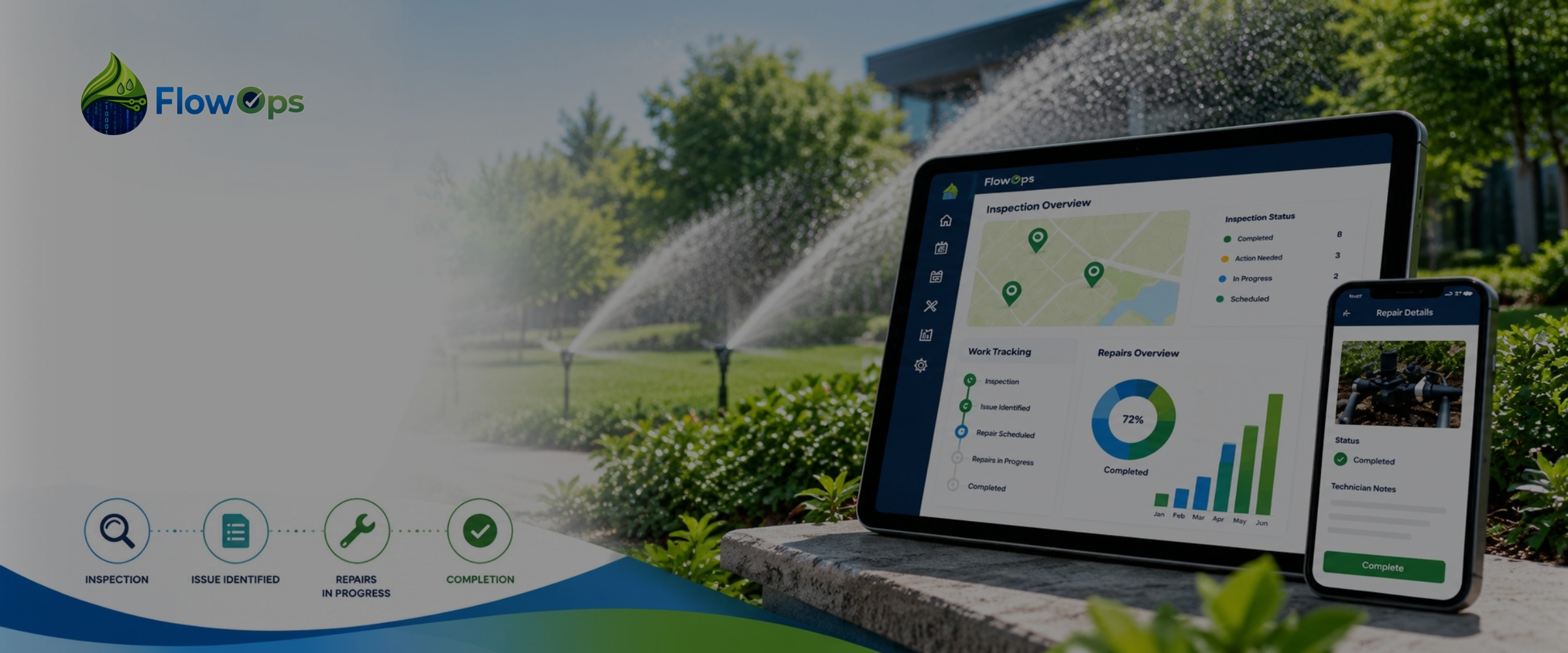
FlowOps is the irrigation maintenance software that turns an inspection finding into a tracked repair the moment a crew documents it. A cracked valve logged during a wet check becomes an open item tied to that property and job, carrying its findings and photos with it, so it exists as something the office can act on rather than a note someone has to spot. From there its status moves as the work moves, through Bid Generation into a quote, through approval, and on to completion, with the open backlog of found repairs visible in one place instead of scattered across reports.
Because the finding and the repair are the same record, nothing has to be re-entered to move a repair forward, and nothing gets lost in a handoff between the inspection and the fix. The crew's documentation becomes invoice-ready field reports once the work is done, so a completed repair is billed from the same record that first identified it. FlowOps keeps the repair alive from the inspection that found it to the completion that closes it, which is the stretch where irrigation operations usually leak the most.
The Repair Is Only Finished When It's Closed
Crews find the problems and crews fix them. The repairs that get lost aren't lost in the doing; they're lost in the waiting, in the stretch between found and fixed where a documented repair has to survive as an open item and no system holds it there.
When every finding becomes a tracked repair that stays visible from inspection to completion, repairs stop aging out in notes, the backlog becomes a list the office can actually work on, and the client stops being the one who notices a problem was never closed. That's where FlowOps fits. To see how it tracks repairs from inspection to completion for your crews, request a demo.
Frequently Asked Questions
What does it mean to track a repair from inspection to completion?
It means a repair a crew finds during an inspection becomes an open, tracked item that carries a status through every stage, identified, quoted, approved, scheduled, and done, until it's closed. Instead of a finding sitting in a report waiting for someone to notice it, the repair stays visible and owned from the moment it's documented to the moment it's completed and billed.
Why do identified repairs so often go uncompleted?
Usually because the finding is captured but nothing tracks it afterward. A note without a status, an owner, or a place in a visible backlog tends to drift, especially when the office is busy and the next week of inspections buries it. The repair didn't fail because it couldn't be fixed. It fails because no system kept it open until someone acted.
How does tracking repairs protect revenue?
The diagnostic work is already paid for once a crew finds a problem. If that finding never becomes a quote and a completed repair, the company spent the time to discover the issue and collected nothing. Tracking every finding to completion means found repairs actually get sold and done, so the discovery work turns into revenue instead of an invisible loss.
How is irrigation maintenance software different from an inspection app?
An inspection app is built to capture what a crew sees. Irrigation maintenance software is built to carry what they found all the way to done, tracking each repair through its stages and keeping the backlog of open work visible. Recording the finding is the starting point; maintaining it as a tracked item until it's closed is what actually gets repairs completed.
Does tracking repairs this way help with client retention?
It does. A client who learns that a problem was flagged and never followed up reads that as disorganized or indifferent. A contractor who closes the loop on every finding shows up as reliable and thorough. Consistently tracking repairs to completion is a large part of why commercial clients keep a contract.