The landscaping industry has evolved significantly. Clients expect real-time updates. Municipal authorities require detailed compliance records. Commercial contracts demand accountability and documentation. Meanwhile, field crews working across multiple properties need immediate access to job information, inspection reports, and work orders.
Landscape management software is no longer a convenience. It has become the operational backbone connecting field teams, office staff, clients, and business systems into a single connected workflow.
This guide explores what landscape management software does, who needs it, and the features that separate the platforms that hold up in the field from the ones that simply look impressive during a sales demonstration.
What Is Landscape Management Software?
Landscape management software is a centralized digital platform designed to manage scheduling, inspections, reporting, estimating, irrigation maintenance, compliance tracking, and field operations.
At a basic level, it replaces paper forms and manual processes. At a more advanced level, it helps coordinate multiple crews across numerous properties while automatically connecting field data to accounting, billing, ERP, and CRM systems.
The most effective landscape business software enables field technicians to capture information directly from mobile devices while working on-site. This ensures that critical operational data is collected once and used throughout the organization without duplicate data entry.
Who Needs Landscape Management Software?
Any landscaping or irrigation company managing multiple clients can benefit from landscape management software. However, the greatest value is realized by organizations handling large-scale commercial operations.
This includes:
- Commercial landscaping contractors managing maintenance contracts across multiple properties
- Irrigation service providers performing seasonal inspections, startups, shutdowns, and wet checks
- Landscape compliance teams responsible for water conservation documentation and municipal reporting
- Operations managers and field supervisors oversee multiple crews and service locations
The common challenge across these businesses is operational complexity. More crews, more properties, and more documentation requirements create a level of coordination that spreadsheets and paper forms cannot effectively support.
Why Landscape Companies Are Moving Away from Manual Processes
Without modern software, important information often becomes scattered across notebooks, text messages, emails, and disconnected spreadsheets.
Common challenges include:
- Lost job notes and incomplete service records
- Delayed reporting from field teams
- Inaccurate irrigation inspection documentation
- Slow estimate generation
- Billing delays caused by missing paperwork
- Increased compliance risks during audits
According to landscaping industry resources from the National Association of Landscape Professionals, operational efficiency and technology adoption continue to play an increasingly important role in helping companies improve productivity and profitability.
When field data is captured and processed digitally, documentation becomes part of the workflow instead of an administrative burden completed after the work is finished.
How Modern Landscape Management Software Works
Modern landscape management platforms operate through three connected components:
- Mobile applications for field crews
- Web dashboards for office staff and managers
- Integrations with accounting, ERP, and customer management systems
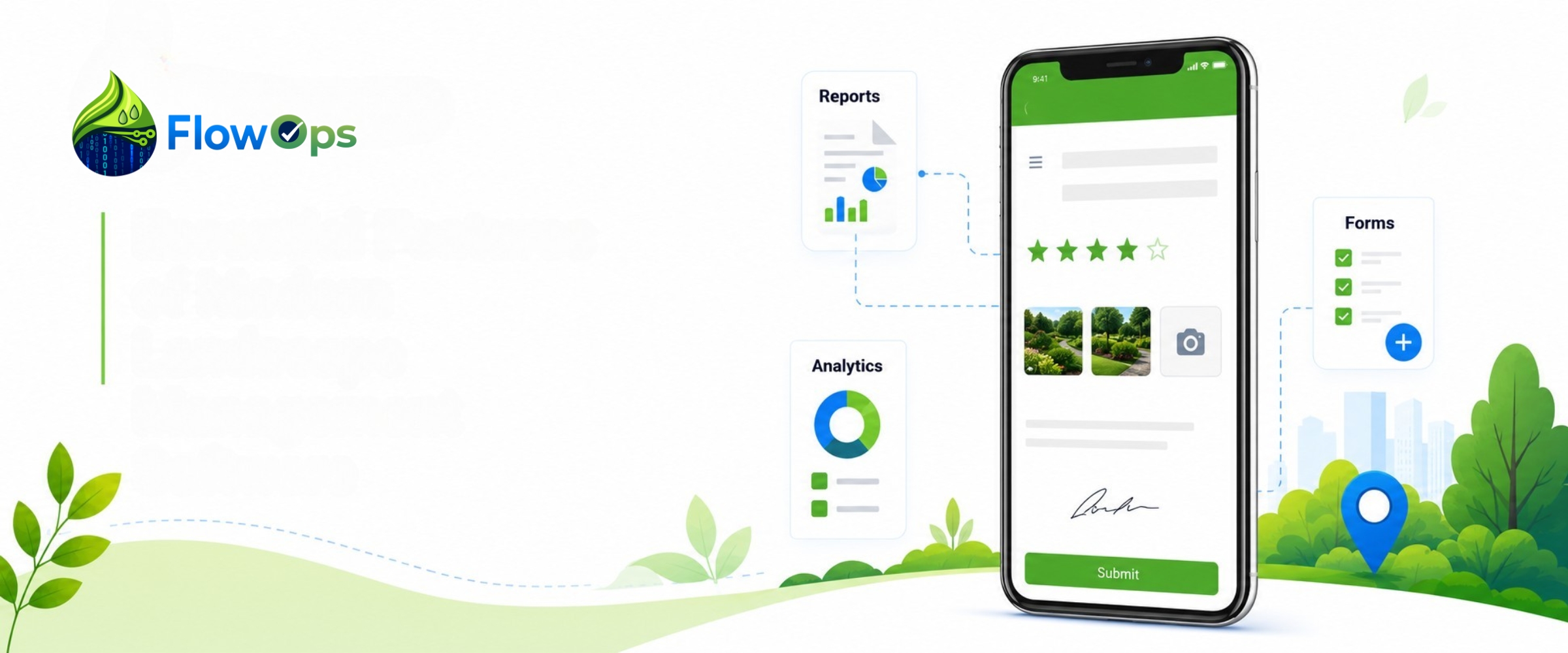
For example, a technician can open a work order on a mobile device, perform an irrigation inspection, document findings with photos, record system readings, identify repair requirements, and submit the report immediately from the property.
The completed report automatically becomes available to office staff, estimate workflows are triggered, and compliance records are generated without requiring additional administrative work.
This connected workflow improves accuracy, reduces delays, and moves information cleanly from the field to the office.
Why Wet Check Software Is Important for Irrigation Operations
Wet checks remain one of the most important services performed by commercial irrigation teams.
A proper wet check requires technicians to:
- Verify the operation of every irrigation zone
- Assess water distribution performance
- Identify leaks and damaged components
- Evaluate pressure issues
- Document deficiencies and repair recommendations
When crews rely on paper forms or disconnected processes, documentation often becomes a bottleneck. Valuable time is spent transferring information rather than performing billable work.
Purpose-built irrigation inspection software eliminates this issue by connecting inspections directly to reporting and estimating workflows.
The result is faster turnaround times, improved documentation quality, and a more efficient path from inspection to repair approval.
Wet Check Workflow Comparison
| Process Area | Traditional Paper Process | Modern Digital Workflow |
|---|---|---|
| Inspection Documentation | Manual notes and forms | Structured digital forms with photos |
| Estimate Creation | Separate office process | Generated directly from inspection findings |
| Compliance Records | Created after the fact | Created during inspection |
| Billing Preparation | Manual data entry | Automated workflow integration |
| Data Accessibility | Limited visibility | Real-time access |
| Offline Functionality | Not available | Full offline capability with synchronization |
Irrigation Repair Tracking and Compliance Documentation
Two of the most important capabilities within landscape management software are irrigation repair tracking and compliance management.
Repair tracking allows organizations to document:
- Identified issues
- Repairs performed
- Materials used
- Outstanding deficiencies
- Property-specific maintenance history
For commercial clients managing large campuses, retail centers, and municipal facilities, this level of documentation is essential.
Compliance tracking is equally important. Water conservation regulations, irrigation audits, and commercial maintenance agreements increasingly require detailed records that can be produced on demand.
Capturing this information at the point of service significantly reduces risk while improving accountability.
Why Mobile Landscape Inspection Software Matters
Modern landscaping operations depend on mobility.
Field crews often work in areas with unreliable cellular coverage, making offline functionality a critical requirement.
The best mobile landscape inspection software allows technicians to:
- Complete inspections without internet access
- Capture photos and service documentation
- Record irrigation data in real time
- Synchronize information automatically once connectivity returns
Without offline capability, field productivity suffers, and important information can be lost.
The Importance of ERP Integration for Landscaping Companies
As landscaping businesses grow, disconnected software systems create operational inefficiencies. Accounting, payroll, project management, and customer records all rely on accurate field data.
Without integration, staff must manually reenter information between systems, increasing labor costs and introducing errors. Modern landscape management software should connect directly with ERP and billing platforms so operational data flows automatically throughout the organization.
This eliminates duplicate work and improves reporting accuracy.
Essential Features That Every Landscape Management Software Platform Should Include
When evaluating landscape business software, look for the following capabilities:
- Mobile first architecture
- Offline functionality
- Structured wet check workflows
- Irrigation inspection forms
- Integrated estimate generation
- Irrigation repair tracking
- Compliance documentation tools
- ERP and billing integration
- Real-time field visibility
- Automated reporting capabilities
The most effective platforms make documentation a natural part of field operations rather than a separate administrative task.
Ready to Modernize Your Landscape Operations?
The landscaping industry is becoming more data-driven, compliance-focused, and operationally complex. Companies that continue relying on paper forms and disconnected workflows often struggle to scale efficiently.
Modern landscape management software provides the visibility, accountability, and efficiency required to successfully manage commercial landscaping and irrigation operations.
FlowOps is designed specifically for landscape and irrigation professionals who need wet-check execution, repair tracking, compliance documentation, estimate generation, and operational visibility in a single platform.
Instead of losing time moving information between the field and the office, your teams can focus on the work in front of them while the software handles the documentation.
If you are ready to improve productivity, strengthen compliance, and tighten your field operations, now is the time to modernize how your business works.