In many irrigation companies, digital inspection forms are still the exception rather than the rule, and inspection reporting depends on a disconnected workflow between the field and the office.
Technicians complete wet checks on-site. Notes are written by hand or entered into separate systems. Photos are uploaded later. Office staff review the information, organize documentation, verify findings, and build customer-facing reports after the visit is already complete.
At low inspection volume, the process appears manageable. As service volume increases across crews and properties, the coordination burden becomes harder to ignore.
The operational issue is not paperwork by itself. The issue is the amount of labor required to move field observations into usable documentation.
That delay affects more than reporting. It affects proposal turnaround, billing speed, customer communication, and the ability to verify compliance records when disputes occur later.
Reporting Delays Usually Start With Repeated Handling
In most operations, the same inspection data gets handled multiple times before it reaches the customer.
A technician documents a leaking valve in the field. An office coordinator later reviews the notes. Photos are matched to the correct property. Someone verifies the repair description. The information is then recreated inside an estimating or invoicing system before the customer ever sees the recommendation.
None of those steps are individually complicated. The problem is cumulative coordination. As inspection volume increases, small delays compound into larger operational slowdowns:
- Proposals wait for missing information
- Customer approvals take longer
- Office staff spend more time clarifying field notes
- Repair opportunities sit unquoted
- Billing cycles extend
In these cases, the repair work itself is not delayed because crews are unavailable. The delay comes from administrative handling between inspection and approval.
This is why reporting lag becomes an operational issue rather than an office issue. Revenue generation depends on how quickly accurate field information moves through the system.
How Digital Inspection Forms Strengthen Compliance Documentation
Inspection documentation often becomes important after the visit is complete.
Runoff complaints, overspray disputes, damaged hardscape claims, and slip-and-fall incidents frequently depend on whether reliable inspection records exist showing site conditions at the time of service.
Paper forms and disconnected reporting systems make that difficult to verify consistently, especially across multiple crews or branches. Photos may exist without timestamps. Notes may be incomplete. Inspection details may be reconstructed later from memory rather than documented during the visit itself.
The problem is not usually a lack of effort from field teams. The problem is that unstructured reporting creates inconsistency.
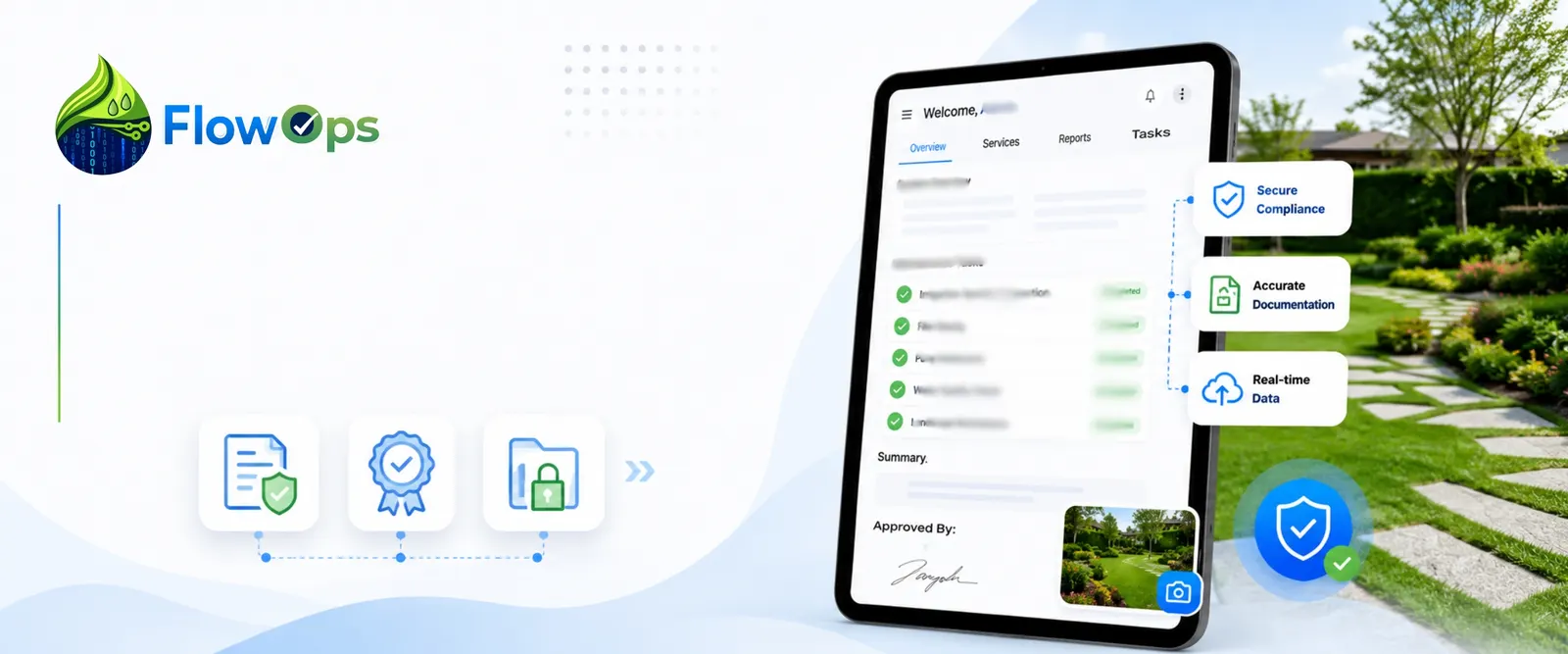
Digital inspection forms reduce that inconsistency by standardizing how inspections are documented in the field. Required fields, technician verification, time-stamped photos, GPS records, and zone-level observations create a clearer compliance record without requiring office staff to reconstruct inspections afterward.
The Coordination Burden Increases as Operations Scale
Many reporting systems work adequately when inspection volume is small. The operational strain appears when companies begin managing more properties, more technicians, and more customer communication simultaneously.
Without consistent inspection workflows:
- Office teams spend more time validating reports
- Customer updates become uneven between crews
- Compliance records become harder to verify
- Estimating workflows slow down
- Repair recommendations take longer to reach approval
At that point, reporting is no longer an administrative task sitting outside operations. It becomes part of operational throughput itself.
This is where standardized digital inspection software changes the picture operationally. Technicians document inspections, upload photos, record repair findings, and submit information directly from the field instead of relying on separate follow-up coordination later.
Platforms like FlowOps support that process by connecting inspection documentation directly to estimating, reporting, and operational workflows. The larger benefit is not the software feature set itself. It is reducing the manual coordination required between field activity and finalized documentation.